Khiva · Sights
Itchan Kala: the walled inner city of Khiva
Every major monument inside Khiva’s walls, how the ticket works, the route our guides walk and when the light is best.
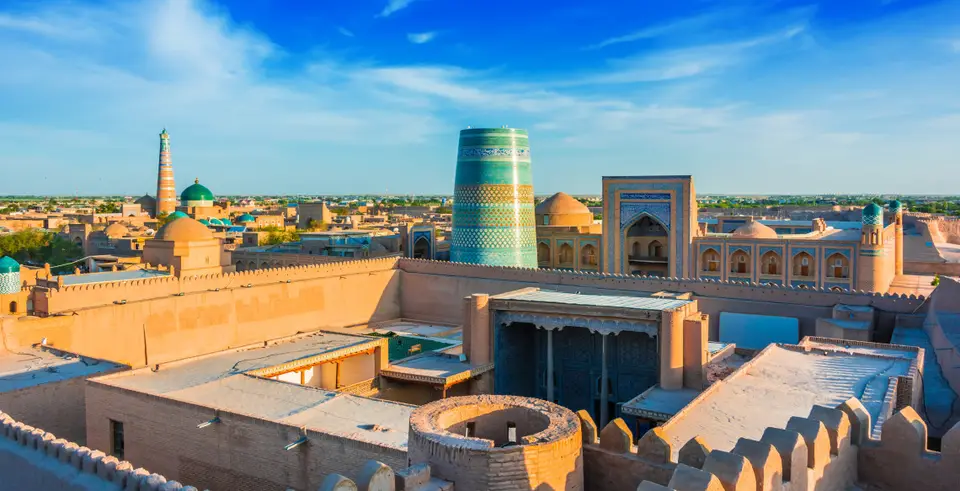
Ichan-Kala is the walled inner city of Khiva, about 26 hectares enclosed by roughly 2 km of mud-brick walls with four gates. It contains more than fifty historic buildings, mostly from the 18th to early 20th centuries, and became Uzbekistan’s first UNESCO World Heritage Site in 1990. One full day covers the main monuments.
What Ichan-Kala is
Ichan-Kala means "inner fortress". It is the old walled core of Khiva, the part that was the khan’s city, while the outer town, Dishan-Kala, grew around it. The walls you see are mostly 18th–19th-century rebuilds on much older foundations: thick, sloping mud-brick ramparts up to about 10 m high, with rounded towers at intervals.
Inside, the city is compact and dense. Madrasahs (religious colleges), mosques, minarets, mausoleums, palaces, caravanserais and houses fill a rectangle that you can cross in about fifteen minutes on foot. Many madrasahs now hold small museums or craft workshops, and a few are hotels. About two thousand people still live inside the walls, which is why Ichan-Kala feels like a town and not an open-air museum.
UNESCO inscribed Ichan-Kala in 1990, the first site in Uzbekistan to be listed.
The four gates
| Gate | Side | Meaning | Notes |
|---|---|---|---|
| Ota Darvoza | West | "Father gate" | The main entrance, beside Kalta Minor. Ticket office. Rebuilt in the 1970s. |
| Bogcha Darvoza | North | "Garden gate" | Leads to the ramparts used for the sunset view. |
| Polvon Darvoza | East | "Strongman gate" | Opens onto the bazaar and the Allakuli Khan caravanserai. Historically the slave market was nearby. |
| Tosh Darvoza | South | "Stone gate" | Quieter, used by residents. |
Our company name comes from these gates: darvaza (in Uzbek, darvoza) means "gate".
The monuments, in walking order
This is the route our guides usually walk, starting at the west gate and finishing at the east gate. It takes five to six hours with museum visits and a break.
1. Kalta Minor and the Muhammad Amin Khan madrasah
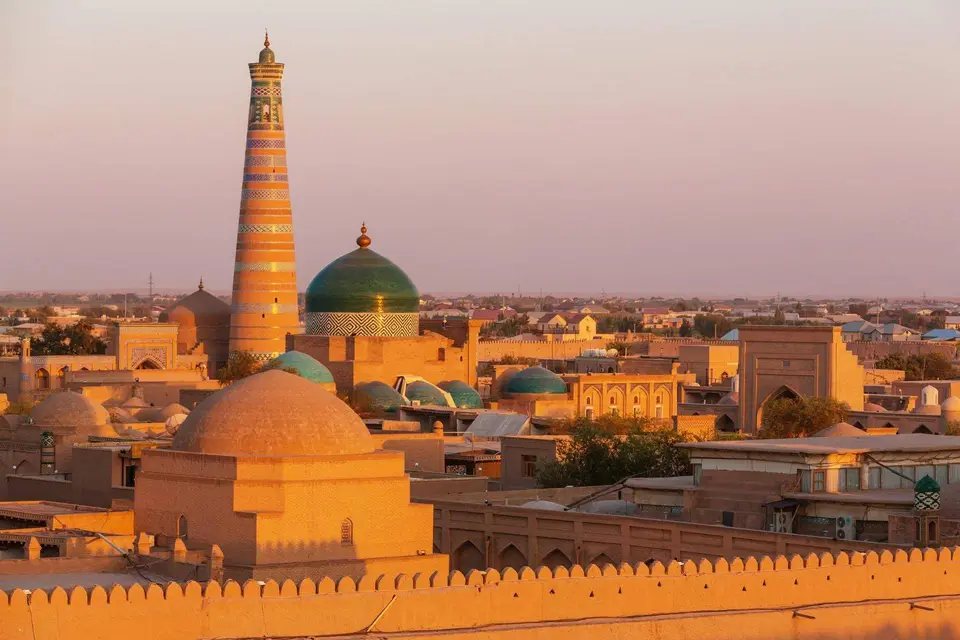
Just inside the west gate. Muhammad Amin Khan began Kalta Minor ("short minaret") around 1851, meaning it to be the tallest minaret in the Islamic world. He died in 1855 and the tower stopped at about 29 m. The stump is wide, about 14 m across at the base, and covered completely in glazed tiles of turquoise, blue and white. The madrasah beside it, built at the same time, is the largest in Khiva.
2. Kunya-Ark
The "old fortress" was the khans’ own walled residence from the 17th century. Inside are the open-sided summer mosque, faced with blue and white tiles; the kurinish-khana, the throne courtyard where the khan received visitors; the old mint; and the Akshikh-bobo bastion, a lookout with a close view of Kalta Minor and the roofs. Climb it in the late afternoon.
3. Muhammad Rakhim Khan madrasah
Facing the Kunya-Ark across a small square, this 19th-century madrasah is named after the khan who was also a poet and patron of the arts. It houses exhibits on the last period of the khanate.
4. Juma Mosque
The Friday mosque is unlike any other in Central Asia: a single low hall with no domes, its flat roof held up by more than 200 carved wooden columns. The present building dates from the late 18th century, but some columns are much older and were reused from earlier mosques. Light comes from two openings in the roof. Stand in the middle and let your eyes adjust. The minaret next to it can sometimes be climbed.
5. Tosh-Hovli Palace
"Stone courtyard", built by Allakuli Khan in the 1830s. The harem courtyard is lined with tall iwans (open porches) covered in deep blue majolica, with carved wooden columns on stone bases. It is the finest tilework in Khiva.
6. Allakuli Khan madrasah, caravanserai and tim
By the east gate. The caravanserai and the covered market (tim) once served caravans arriving from the desert. Today they hold shops and the start of the bazaar outside the walls.
7. Pahlavon Mahmud mausoleum
The shrine of Pahlavon Mahmud, a 13th–14th-century poet, furrier and champion wrestler who became Khiva’s patron saint. The present complex was rebuilt in the 19th century under the city’s largest turquoise dome, and the khans chose to be buried near him. It is an active shrine: dress modestly and be quiet inside.
8. Islam Khoja madrasah and minaret
The last great buildings of Khiva, completed in 1910 by Islam Khoja, a reforming grand vizier. The minaret is the tallest in the city, often quoted as about 57 m including the base. There are more than a hundred steep, narrow steps to the top. The madrasah holds the museum of applied arts.
Also worth finding
- Sayid Alauddin mausoleum, one of the oldest surviving buildings inside the walls (14th century), small and easy to miss.
- Shirgazi Khan madrasah (1720s), traditionally said to have been built by enslaved Persians.
- Abdullah Khan and Kutlug Murad Inak madrasahs, quiet courtyards off the main street.
- Wood-carving and carpet workshops in the side lanes, where you can watch the craft that produced the Juma Mosque columns.
Tickets and opening hours
Ichan-Kala is managed as a museum-reserve. The general pattern in recent seasons:
- A combined ticket, sold at the west gate (Ota Darvoza), covers most museums and monuments inside the walls. It has usually been valid for more than one day; ask at the desk.
- Separate small fees apply to a few things, typically climbing the Islam Khoja minaret, the Kunya-Ark bastion lookout and the ramparts, and sometimes taking photos inside certain museums.
- Museums generally open from about 9:00 to the early evening. The lanes, squares and the outside of the monuments can be enjoyed at any hour, and the old town is lit after dark.
- Pay in cash (som) to be safe; card terminals are not always working.
Prices and rules change from season to season, so we do not print figures that may be out of date. If you travel with us, entrance fees are arranged for you.
When to visit and the best light
- Early morning (7:00–9:00): almost empty lanes, soft light on the west side of Kalta Minor and the Muhammad Amin Khan madrasah. Best time for the Islam Khoja minaret climb before it gets hot.
- Midday: the hardest light and, from May to September, real heat. Spend it inside the Juma Mosque, Tosh-Hovli and the museums.
- Late afternoon: the walls glow ochre. Climb the Kunya-Ark bastion or the northern ramparts about an hour before sunset.
- After dark: day groups have left, the monuments are lit and the main street fills with local families. This is one of the reasons to stay at least one night.
Spring (April–May) and autumn (September–October) are the most comfortable months. In July, afternoon temperatures often pass 40 °C.
Practical tips
- Shoes: the ramparts and minaret stairs are steep, uneven and partly unlit; there are no railings on parts of the walls.
- Dress: cover shoulders and knees for the Pahlavon Mahmud shrine and the mosques.
- Water and shade: there are cafés and small shops all along the main street between the west and east gates.
- A guide helps. Many buildings look alike from the outside. A guide who knows the stories of the khans, the craftsmen and the legends makes the day far richer. Our guides live in Khiva.
- Accessibility: the main street is paved and mostly flat, but many monuments have steps and high thresholds.
Frequently asked questions
How long do you need in Ichan-Kala?
One full day covers the main monuments at a comfortable pace, about five to six hours with museum visits. Staying overnight lets you add the sunset from the walls and the quiet early morning.
Is Ichan-Kala free to enter?
You can walk the lanes freely, but the old town is a museum-reserve and most monuments and museums are covered by a combined ticket sold at the west gate. A few sights, such as the Islam Khoja minaret, charge a small extra fee. Rules change, so ask at the gate.
Can you climb the walls of Khiva?
Yes, sections of the ramparts can be climbed, most popularly the northern stretch near the Bogcha Darvoza for the sunset view. A small fee is often charged. The path is uneven and has no railings in places.
What is the difference between Ichan-Kala and Khiva?
Ichan-Kala is the walled inner city, the historic core with most of the monuments. Khiva is the whole town, including the outer town (Dishan-Kala) and the modern city around it.
Why is Kalta Minor unfinished?
Muhammad Amin Khan started it around 1851 to be the tallest minaret in the Islamic world, but he died in 1855 and work stopped. Legends add that the khan of Bukhara planned to have the architect build an even taller one, so the khan of Khiva had him killed. Historians cannot confirm that story.
Rules, timetables and prices change. We check this page regularly, but always confirm entry requirements with official sources before you travel.