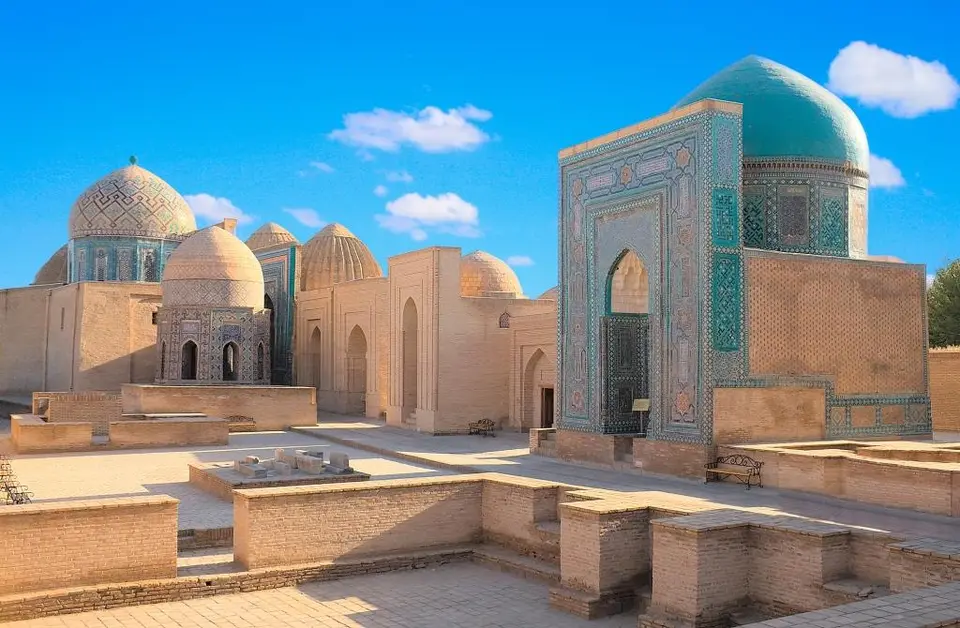
Desert Castles of Uzbekistan & the Seven Lakes of Tajikistan
Tashkent → Khiva → Desert fortresses of Khorezm → Bukhara → Samarkand → Seven Lakes (Haft Kul) → Shakhrisabz
From €1,155 per personView tour
Karakalpakstan & ancient Khorezm · Uzbekistan
Clay castles in the Kyzylkum, and a yurt camp below Ayaz Kala.
The desert castles of Khorezm are ruined mud-brick fortresses built between about the 4th century BC and the 7th century AD, in Karakalpakstan 1.5–2 hours from Khiva. The three easiest to visit together are Toprak Kala, Kyzyl Kala and Ayaz Kala. One day is enough; a night in the Ayaz Kala yurt camp adds sunset and sunrise.
North of Khiva, across the Amu Darya, the edge of the Kyzylkum desert hides the ruins of dozens of fortresses from ancient Khorezm, one of the oldest civilisations of Central Asia. Local people call the area Elliq Qala, the "fifty fortresses", and the district still carries the name Ellikqala.
These were not only castles. Some were royal residences, some fortified towns, some border forts guarding the irrigated oasis against nomads from the steppe. Built of sun-dried mud brick and rammed earth, they have been eroded by two thousand years of wind into soft, sculptural shapes that glow at sunrise and sunset. They are the closest thing Uzbekistan has to a desert archaeological park, and they are an easy day from our office in Khiva.
Don’t miss
A royal residence of ancient Khorezm, with a palace on a high platform above a walled town. Excavations found wall paintings and archives here.
A compact, square fort with thick walls, partly restored, a few minutes from Toprak Kala. A good first stop to understand how the forts were built.
A fortress on a steep ridge with a lower fort and a third enclosure at its foot. The best views of the desert and the salt lake of Akchakul.
Felt yurts below Ayaz Kala, for lunch on a day trip or an overnight stay with dinner, sunset and sunrise.
Further afield, a large fortress with a legend about a princess, and a ring-shaped Zoroastrian "tower of silence" on the road to Nukus.
Khorezm grew up in the delta of the Amu Darya, where the river spreads out before reaching the Aral Sea. From the middle of the first millennium BC, its people dug irrigation canals that turned the desert edge into farmland. To protect the canals, the fields and the trade routes, they built fortified settlements along the boundary between the oasis and the desert.
Over the centuries Khorezm was part of, or neighbour to, the Achaemenid Persian empire, the Kushan world and the nomadic powers of the steppe. When rivers shifted and canals were abandoned, the forts were left in what became open desert. That is why they survive so well: nobody built over them.
Much of what we know comes from the Khorezm Archaeological-Ethnographic Expedition led by the Soviet archaeologist Sergey Tolstov from the late 1930s, which mapped hundreds of sites from the ground and from the air.
Toprak Kala ("earthen fortress") was a royal city of ancient Khorezm in the first centuries AD. A rectangular walled town with a straight central street is dominated at one corner by the palace, raised on a platform about 25 m high. Its halls were decorated with wall paintings and sculpture. Excavators also found documents written in the Khorezmian language, among the earliest written records of the region.
Walk up to the palace platform for the view over the town plan, then around the outer walls. The site is open and unshaded; bring a hat.
Kyzyl Kala ("red fortress") is a small square fort from roughly the same period as Toprak Kala, about 65 m on each side. Part of its walls has been restored, which helps you picture what the other fortresses looked like when they were complete. It takes 20–30 minutes and is usually the first or second stop of the day.
Ayaz Kala is the most dramatic of the castles and the one most travellers remember. There are three parts:
The best light is the last hour before sunset, when the walls turn orange and the desert below goes blue. That is the main reason to stay the night at the yurt camp.
Below the fortress is a yurt camp with traditional felt yurts, shared washrooms and a dining yurt. On a day trip it is where we stop for lunch. As an overnight stay, it gives you dinner under the stars, the sunset climb to Ayaz Kala and sunrise over the desert. The camp is seasonal and closes in the coldest months. Nights can be cold even in spring and autumn, so bring a warm layer.
Some travellers add a short camel ride near the camp. Ask us whether it is available on your dates.
| Day trip from Khiva | With a night in the yurt camp | |
|---|---|---|
| Leave Khiva | about 8:00 | late morning |
| Order | Kyzyl Kala → Toprak Kala → lunch → Ayaz Kala | Kyzyl Kala → Toprak Kala → camp → Ayaz Kala at sunset |
| Back in Khiva | late afternoon | next morning, or continue to Nukus |
| Best months | March–May, September–November | April–May, September–October (camp is seasonal) |
Our desert fortresses day tour from Khiva covers the classic three; the 4-day Aral Sea & Karakalpakstan journey continues north to Nukus and Muynak.
Tours
Tashkent → Khiva → Desert fortresses of Khorezm → Bukhara → Samarkand → Seven Lakes (Haft Kul) → Shakhrisabz
Tashkent → Kokand → Rishtan → Margilan → Khiva → Desert fortresses of Khorezm → Bukhara → Nurata & Lake Aydarkul → Samarkand → Shakhrisabz
Khiva → Desert fortresses of Khorezm
Khiva → Desert fortresses of Khorezm → Nukus → Muynak & the Aral Sea
Things to do
About 1.5–2 hours by road. You drive through Urgench, cross the Amu Darya into Karakalpakstan and continue to the Ellikqala district, where Toprak Kala, Kyzyl Kala and Ayaz Kala are close together.
Yes. A yurt camp below the fortress offers overnight stays with dinner and breakfast in the warmer months. Staying lets you climb to the fortress at sunset and see sunrise over the desert.
Ayaz Kala for its setting and views, Toprak Kala for history, since it was a royal residence with a palace. Most visitors see both, plus Kyzyl Kala, in one day.
They range from roughly the 4th century BC to the 7th century AD. Ayaz Kala 1 is among the oldest; Toprak Kala flourished in the first centuries AD.
No special permit is needed for the main sites. Some have a small entrance fee, collected on site.
Nearby
Darvaza Trip · Koshona street 75/1, Khiva, Uzbekistan · WhatsApp +998 91 920 94 20 · tours.uzbekistan@gmail.com · darvazatrip.com/destinations/uzbekistan/desert-fortresses/