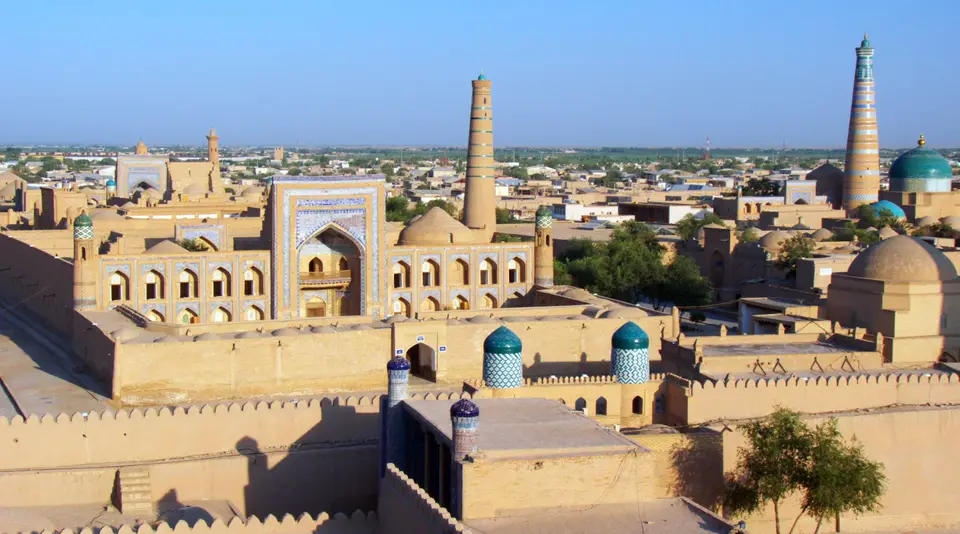
A journey in nine stops
The Silk Road in Central Asia, city by city
Follow the caravans from our home in Khiva across the Kyzylkum desert, through Bukhara and Samarkand, into the Fergana Valley and up to the last caravanserai before China.
There was never one Silk Road. There was a web of tracks between China and the Mediterranean, used for more than fifteen centuries, along which silk, paper, horses, glass, spices, religions and ideas moved one oasis at a time. Few merchants travelled the whole way; goods changed hands from city to city, and the cities of Central Asia grew rich in between.
This page follows one of those threads, west to east, the way we travel it with guests today. Scroll, and the map follows you.
01Oasis of Khorezm
The gate to the desert
Khiva, Uzbekistan
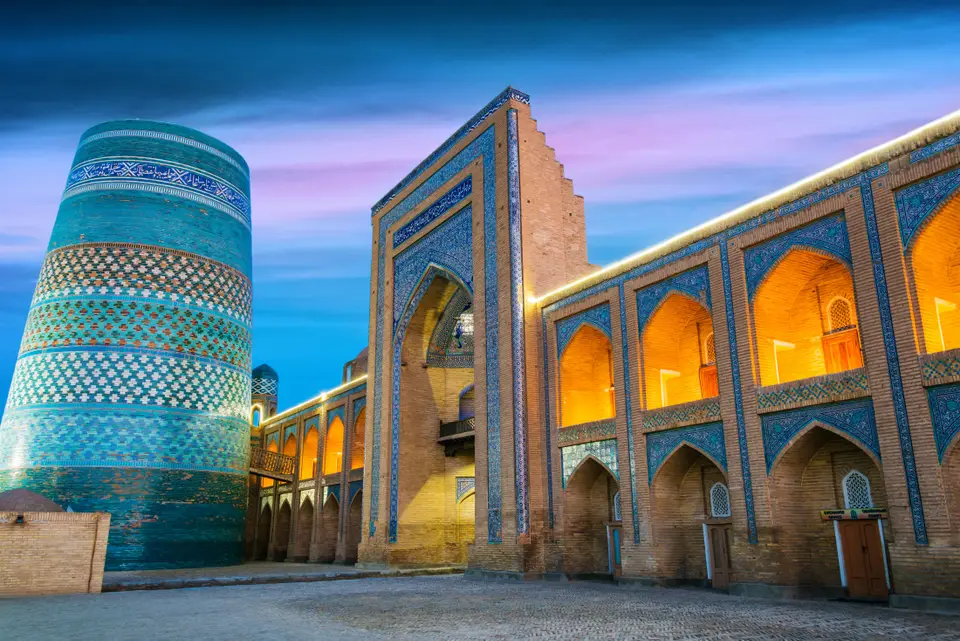
For a caravan heading east from the Caspian, Khiva was the last oasis before the Kyzylkum, the "Red Sands". Water, food, fresh camels and a guide across the desert were all bought here.
The walled inner town, Ichan-Kala, is the best-preserved old town in Central Asia and was the first site in Uzbekistan inscribed by UNESCO, in 1990. Most of what you see was built by the Khans of Khiva in the 18th and 19th centuries: the turquoise stump of the Kalta Minor minaret, begun in the 1850s and never finished, has become the symbol of the city.
02Ancient Khorezm
Before the Silk Road
Desert fortresses of Khorezm, Uzbekistan
North of Khiva, across the Amu Darya, the mud-brick fortresses of ancient Khorezm stand in the desert: Toprak Kala, Ayaz Kala, Kyzyl Kala and dozens more. They are around two thousand years old, older than any building in Khiva.
They guarded an irrigated kingdom on the edge of the steppe, long before the caravan trade made the cities to the south famous. We are based in Khiva, and this is the day trip we know best.
Desert fortresses of Khorezm travel guide 4 tours via Desert fortresses of Khorezm
03The crossing
Across the Red Sands
Kyzylkum desert
Between Khiva and Bukhara lie roughly 450 kilometres of desert. Caravans crossed it from well to well, resting at caravanserais: walled inns with a courtyard for the animals and small rooms for the merchants around it.
Today the same crossing is a long day on the road beside the Amu Darya, or a few hours by train. Either way, you see why the oases on both sides mattered so much.
04Samanids to the Emirs
Bukhara, the trading city
Bukhara, Uzbekistan
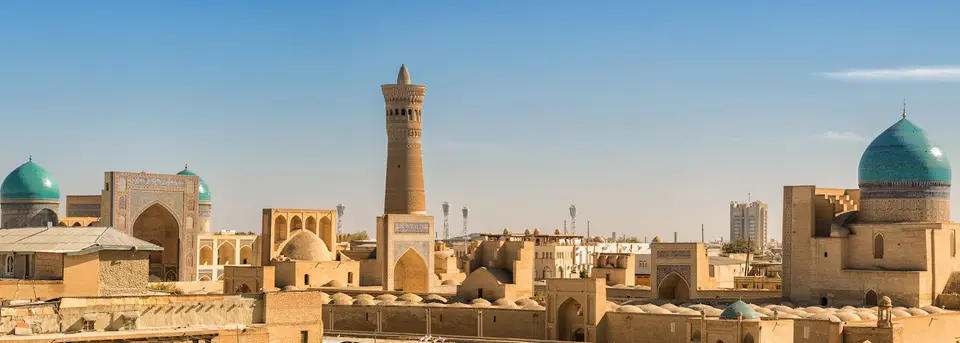
Bukhara was a centre of trade and learning for a thousand years. The brick Samanid Mausoleum dates from the early 10th century; the Kalyan Minaret, finished in 1127, guided caravans across the desert and, the story goes, so impressed Genghis Khan that he spared it.
The covered trading domes of the old town, built in the 16th century at the crossings of busy streets, each once specialised: jewellers under one, money changers under another. Some still sell jewellery, carpets and caps.
05Sogdians to Timur
Samarkand, the crossroads
Samarkand, Uzbekistan
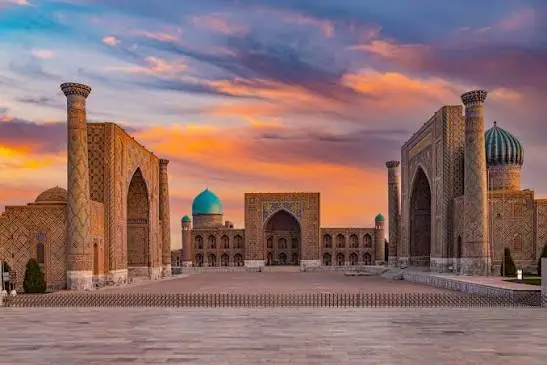
Samarkand was already old when Alexander the Great reached it in 329 BC. In the late 14th century Timur (Tamerlane) made it his capital and brought craftsmen from every land he conquered to build it.
The Registan is framed by three madrasahs built over more than two centuries, from Ulugh Beg's in the 1410s–1420s to Tilya-Kori in the mid-17th century. Ulugh Beg, Timur's grandson, also built an observatory here in the 1420s. Tradition says papermaking reached the Islamic world through Samarkand in the 8th century; you can still watch paper made from mulberry bark nearby.
06The Sogdian merchants
The people of the Silk Road
Penjikent, Tajikistan
If one people deserve the name "Silk Road merchants", it is the Sogdians, whose homeland lay around Samarkand and the Zeravshan valley. From the 4th to the 8th century their trading families ran networks reaching deep into China, and their language was spoken in markets along the route.
Across the border in Tajikistan, the ruins of ancient Penjikent were a Sogdian town. Its houses were decorated with wall paintings of feasts, heroes and gods, now in museums in Penjikent, Dushanbe and St Petersburg.
07Fergana Valley
Silk and heavenly horses
Margilan, Uzbekistan

Around 100 BC, the Chinese Han dynasty sent armies across the mountains to the Fergana Valley for its famous horses, the "heavenly horses" that Chinese chronicles describe. The valley's fertile land later made it a centre of silk.
In Margilan, weavers still make ikat silk by hand: the threads are tie-dyed before weaving, which gives the patterns their soft, blurred edges. In nearby Rishtan, potters glaze bowls in the deep blue of the local clay and minerals.
08Gateway to the mountains
Osh and the sacred mountain
Osh, Kyrgyzstan

Osh, in Kyrgyzstan, is one of the oldest cities in Central Asia. Above it rises Sulaiman-Too, a rocky mountain that has been a place of pilgrimage for centuries; it was inscribed by UNESCO in 2009.
From here the caravans left the valley behind and climbed into the Tian Shan towards Kashgar.
09The last caravanserai
The end of the road, for now
Tash Rabat, Kyrgyzstan
High in a quiet valley near the Torugart Pass, Tash Rabat is a stone caravanserai usually dated to the 15th century, with a domed hall and some thirty small rooms around it. It sheltered travellers before the last climb to the Chinese border.
Beyond it lies Kashgar, and China. Our journeys stop here, but if you follow the caravans this far, you will have crossed the heart of the Silk Road.
Travel it
Silk Road journeys
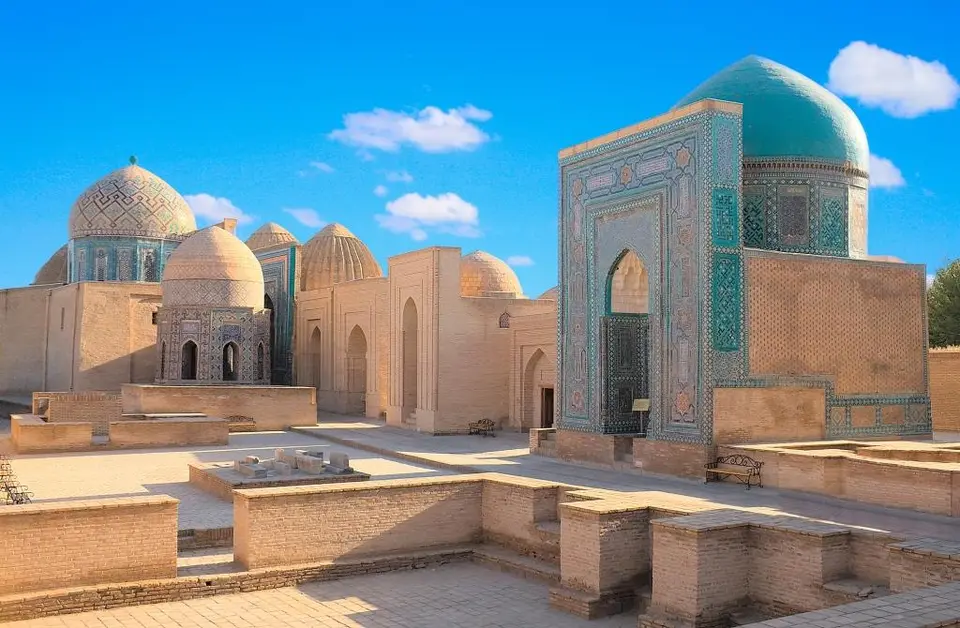
Desert Castles of Uzbekistan & the Seven Lakes of Tajikistan
Tashkent → Khiva → Desert fortresses of Khorezm → Bukhara → Samarkand → Seven Lakes (Haft Kul) → Shakhrisabz

Central Asia grand tour: five countries in 21 days
Ashgabat → Darvaza gas crater → Kunya-Urgench → Khiva → Bukhara → Samarkand → Seven Lakes (Haft Kul) → Tashkent → Margilan → Osh → Bishkek → Song-Kul → Issyk-Kul → Almaty
Follow the caravans with us
We’re based in Khiva, where the desert crossing began. Tell us how long you have and we’ll plan your Silk Road route.