Our home city · Uzbekistan
Things to do in Khiva: a travel guide from locals
A walled city of gates, minarets and mud-brick lanes, and our home.
Khiva is a walled Silk Road city in western Uzbekistan, 35 km from Urgench airport. Its inner town, Ichan-Kala, holds more than fifty monuments inside 2 km of mud-brick walls and was Uzbekistan’s first UNESCO site (1990). Plan two nights: one full day for the old town, one for the desert fortresses nearby.
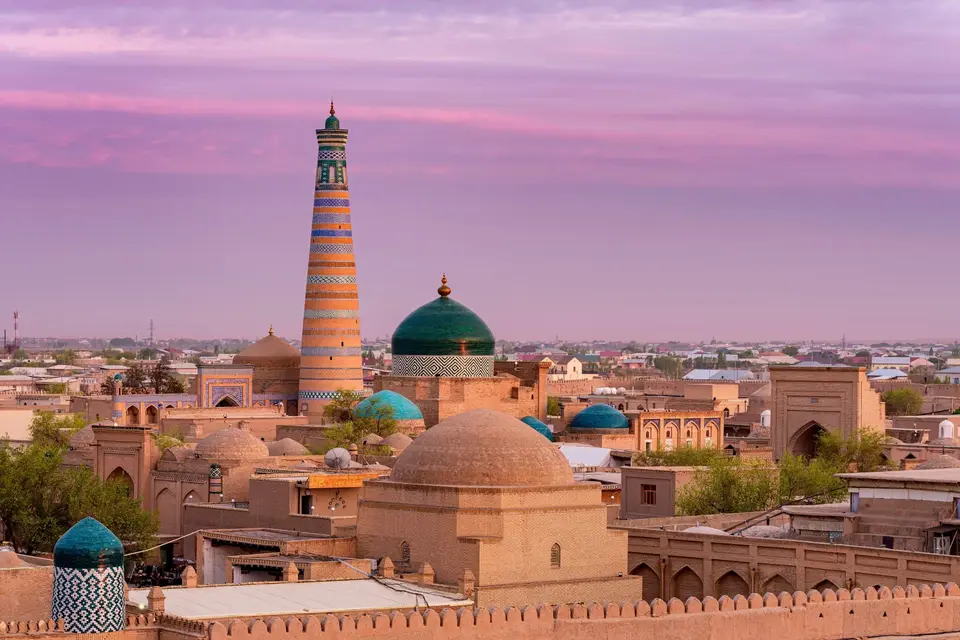
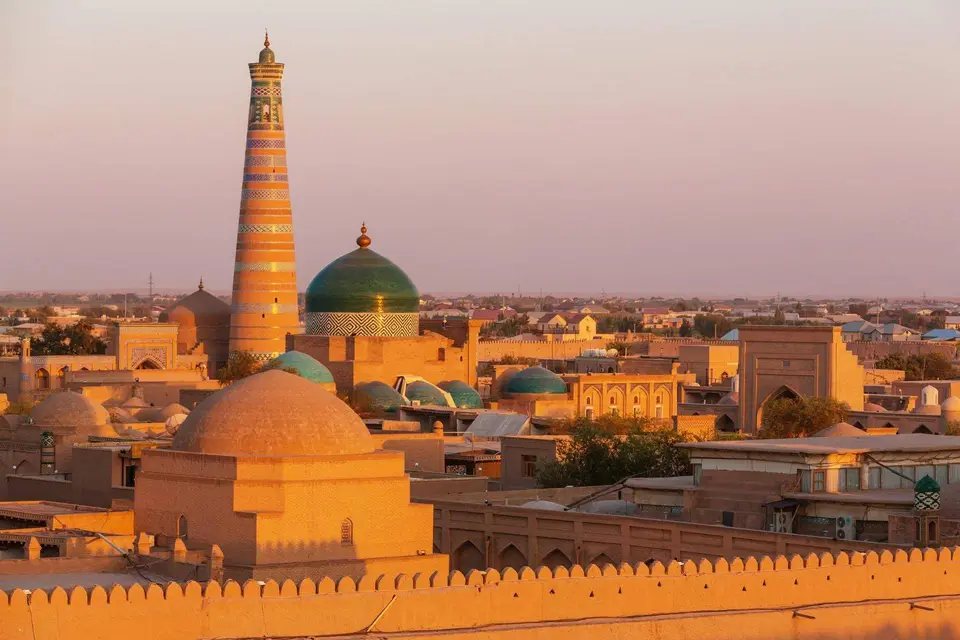
Khiva is where Darvaza Trip is based, and this guide is written from our office a few minutes’ walk from the walls. Inside the fortified inner town, Ichan-Kala, madrasahs, mosques, palaces and minarets stand so close together that you can cross the whole old city in fifteen minutes. That density is what makes Khiva different from Samarkand or Bukhara: here the historic city has survived as a complete town, not as separate monuments in a modern city.
Come for the late-afternoon light on the walls, the quiet lanes after the day-trippers leave, and the food of Khorezm, which is unlike the rest of Uzbekistan. Khiva is also the gateway to the clay castles of ancient Khorezm, to Karakalpakstan and the Aral Sea, and to Turkmenistan across a border less than an hour away.
- Time needed
- 2 nights
- Best time
- April–May and September–October
- Getting there
- Fly to Urgench (about 35 km, 40 minutes by car) or take the train to Khiva station. Bukhara is about 450 km by road across the Kyzylkum. The Shavat–Dashoguz border with Turkmenistan is about an hour away. See Urgench airport to Khiva.
- UNESCO World Heritage
- Inscribed 1990
Plan your visit
Khiva guides
- Day trips from KhivaEvery trip worth taking from Khiva, compared by drive time and effort, from the clay castles of Khorezm to the Aral Sea.
- Ichan-Kala monumentsEvery major monument inside Khiva’s walls, how the ticket works, the route our guides walk and when the light is best.
- Khiva foodThe dishes that make Khorezm cooking different from the rest of Uzbekistan, and how to find them in Khiva.
- Khiva in 1–2 daysHour-by-hour plans for one day, two days and three days in Khiva, timed around the heat, the crowds and the light.
- Where to stay in KhivaInside Ichan-Kala, just outside the gates or in the newer town? What each area is like, the types of hotel, and how to choose.
- Urgench airport to KhivaHow to get from Urgench airport (UGC) to Khiva, how long it takes, late-night arrivals and travelling on to Bukhara or Nukus.
Don’t miss
What to see in Khiva
- 01
Ichan-Kala walls & gates
Enter through Ota Darvoza, the west gate, and climb the northern ramparts near the Bogcha Darvoza for the sunset view over the roofs.
- 02
Kalta Minor
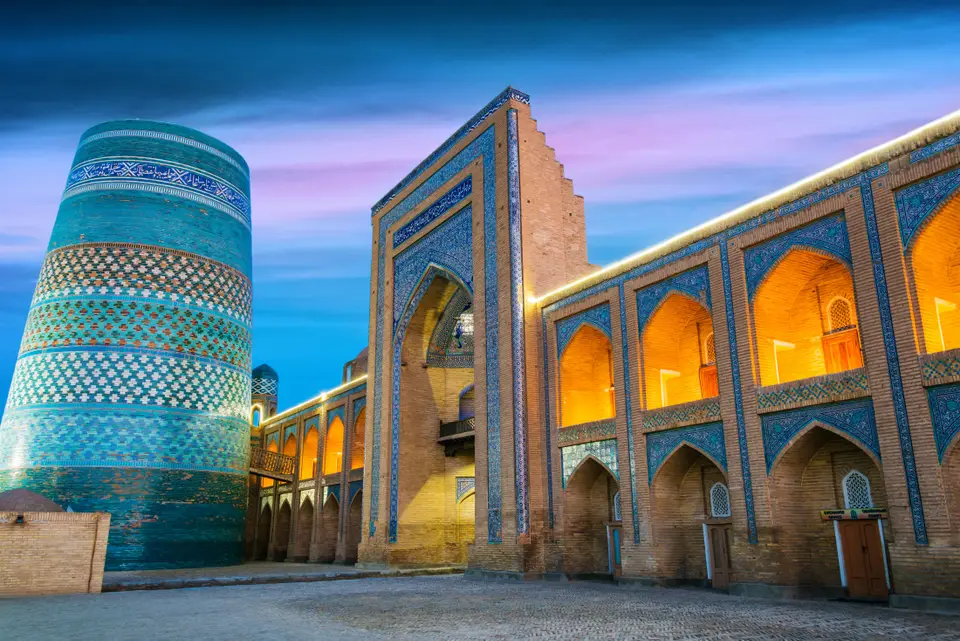
The fat, unfinished minaret covered in turquoise tiles, begun in the 1850s and abandoned when its khan died. It is the city’s symbol.
- 03
Juma Mosque
A low, dim prayer hall held up by more than 200 carved wooden columns, some of them far older than the 18th-century building.
- 04
Kunya-Ark
The khans’ fortress-residence, with a tiled summer mosque, a throne courtyard and the Akshikh-bobo bastion looking over the old town.
- 05
Tosh-Hovli Palace
Built in the 1830s by Allakuli Khan, with deep blue tiled iwans around the courtyards of the former harem.
- 06
Pahlavon Mahmud Mausoleum
Shrine of the poet and wrestler who became Khiva’s patron saint, under the largest turquoise dome in the city. Still a place of pilgrimage.
- 07
Islam Khoja minaret
Completed in 1910, the tallest minaret in Khiva. The climb is narrow and steep, and the view is the best in town.
- 08
Dishan-Kala and Nurullaboy Palace
Outside the inner walls, the outer town has its own gates and the early-20th-century palace of the last khans.
Khiva in brief
Khiva sits in the delta lands of the Amu Darya in the Khorezm region, one of the oldest oases of Central Asia. Local legend says the city grew around a well dug by Shem, son of Noah; historians can show that a settlement existed here at least two thousand years ago. Khiva’s great period came late. From the 17th century it was the capital of the Khanate of Khiva, and most of the buildings you see today date from the 18th to the early 20th century, when the khans rebuilt the city in brick and tile.
The old town has two rings. Ichan-Kala (the inner fortress) is the walled core, about 26 hectares, with most of the monuments. Dishan-Kala (the outer town) grew around it and was enclosed by a second wall in the 1840s. Today people live in both. Ichan-Kala is a museum-reserve, but it is also a neighbourhood, with families, schoolchildren and small workshops in the side lanes.
Top things to do in Khiva
- Walk the walls at sunset. The northern stretch of the rampart, reached near the north gate, faces west over the roofs and minarets. Arrive about an hour before sunset.
- See Kalta Minor and the Muhammad Amin Khan madrasah by the west gate, ideally twice: in the morning sun and again at blue hour when the tiles glow.
- Stand among the columns of the Juma Mosque. Look for the oldest columns: they are narrower at the base, with darker, more worn carving.
- Climb the Islam Khoja minaret for the view over the whole walled city and the desert beyond. Go early, before the stairway gets busy.
- Explore the Kunya-Ark and climb its bastion, the Akshikh-bobo, for the closest view of Kalta Minor from above.
- Visit Tosh-Hovli, the palace with the most beautiful tilework in Khiva.
- Watch craftsmen at work. Khiva is known for carved wood (the columns and doors are a living craft) and for silk carpets and suzani embroidery copied from the city’s tile patterns.
- Eat shivit oshi, the green dill noodles of Khorezm, and tukhum barak, egg-filled dumplings you will not easily find elsewhere. See our Khiva food guide.
- Walk outside the walls to the Nurullaboy Palace and the bazaar near the east gate, where Khiva shops for its own needs.
- Take a day trip into the desert to Ayaz Kala and Toprak Kala, 2,000-year-old clay castles on the far side of the Amu Darya.
For detail on every monument, tickets and the best route through the old town, read our Ichan-Kala guide.
How many days in Khiva?
Two nights is right for most travellers. Arrive in the afternoon and walk the walls at sunset. Spend the next day in Ichan-Kala, then use a second full day for the desert fortresses or a slower morning in the old town. With one night you will see the main monuments, but you will miss the quiet evening and early-morning hours that make Khiva special. With three nights you can add a night in the yurt camp below Ayaz Kala, or go on to Nukus and the Savitsky Museum.
Our Khiva in 1 or 2 days itinerary gives an hour-by-hour plan.
Best time to visit Khiva
Khiva has a desert climate, with hot summers, cold winters and little rain.
| Months | What to expect |
|---|---|
| April–May | The best season. Warm days, cool evenings, green oasis fields. Busiest with groups. |
| June–August | Very hot. Afternoon temperatures often pass 40 °C in July. Sightsee early and late, rest at midday. Melons ripen from late summer. |
| September–October | Excellent. Warm, settled weather and harvest season. Busy, especially late September. |
| November–March | Cold, often below freezing at night in January, but bright and very quiet. Some cafés close; the monuments stay open. |
For photographers, the old town faces the setting sun best from the north-west ramparts. Kalta Minor is lit from the front in the morning.
Getting to Khiva
- By air: the nearest airport is Urgench (UGC), about 35 km away. There are daily flights from Tashkent, taking about 1 hour 40 minutes. The drive to Khiva takes around 40 minutes. See Urgench airport to Khiva.
- By train: Khiva has had its own railway station since 2018, just outside the walls. Trains run from Tashkent via Samarkand and Bukhara. Check the current timetable and train type in our trains guide.
- By road from Bukhara: about 450 km and 6–7 hours across the Kyzylkum desert. The road follows the Amu Darya for a stretch, the river that forms the border with Turkmenistan. It is a long but interesting day with a private driver.
- From Turkmenistan: the Shavat–Dashoguz crossing is about an hour from Khiva, the usual route to Kunya-Urgench and the Darvaza crater.
Khiva and the region around it
Khiva is the best base for western Uzbekistan. From here our team runs day trips to the desert fortresses and longer journeys into Karakalpakstan: Nukus and its museum, and Muynak and the Aral Sea. Across the border are Kunya-Urgench, the older capital of Khorezm, and the Darvaza gas crater. Our day trips from Khiva page compares all the options by time and effort.
Practical tips from our team
- Stay inside or close to the walls so you can walk out at dawn and after dark. See where to stay in Khiva.
- Bring cash in som. Card acceptance has improved in hotels and larger restaurants, but small shops, craft stalls and some ticket desks still prefer cash.
- Dress for a living town. Shoulders and knees covered at the Pahlavon Mahmud shrine and in mosques; elsewhere, normal summer clothing is fine.
- Wear good shoes. The ramparts and minaret stairs are steep and uneven, and there are no handrails on parts of the walls.
- Ask before photographing people, especially women and children in the residential lanes.
Photos of Khiva
Tours
Tours that include Khiva
Desert Castles of Uzbekistan & the Seven Lakes of Tajikistan
Tashkent → Khiva → Desert fortresses of Khorezm → Bukhara → Samarkand → Seven Lakes (Haft Kul) → Shakhrisabz

Central Asia grand tour: five countries in 21 days
Ashgabat → Darvaza gas crater → Kunya-Urgench → Khiva → Bukhara → Samarkand → Seven Lakes (Haft Kul) → Tashkent → Margilan → Osh → Bishkek → Song-Kul → Issyk-Kul → Almaty
Uzbekistan essentials in 7 days
Tashkent → Khiva → Bukhara → Samarkand
Uzbekistan & Kyrgyzstan: cities and mountains, 14 days
Tashkent → Khiva → Bukhara → Samarkand → Bishkek → Issyk-Kul → Karakol → Song-Kul
Uzbekistan in depth: 12 days
Tashkent → Kokand → Rishtan → Margilan → Khiva → Desert fortresses of Khorezm → Bukhara → Nurata & Lake Aydarkul → Samarkand → Shakhrisabz
Things to do
Experiences in Khiva
Khiva: frequently asked questions
Is Khiva worth visiting?
Yes. Khiva is the most complete historic town in Central Asia. Its inner city survives as a whole, walls and all, rather than as monuments scattered through a modern city. Combined with the desert fortresses nearby, it is the highlight of many travellers’ trips to Uzbekistan.
How many days do you need in Khiva?
Two nights is ideal. That gives one full day in Ichan-Kala and a second for the desert fortresses or a slower morning. One night is enough to see the main sights, but you miss the evenings and early mornings.
How do I get from Urgench airport to Khiva?
Khiva is about 35 km from Urgench airport, roughly 40 minutes by car. Most travellers take a pre-booked transfer or a taxi. See our Urgench airport to Khiva guide.
Do I need a ticket to enter Ichan-Kala?
The old town is a museum-reserve. A combined ticket covers most of its museums and monuments, and a few sights, such as climbing the Islam Khoja minaret, have separate small fees. Ticket rules change, so check our Ichan-Kala guide before you go.
Can I visit Turkmenistan from Khiva?
Yes. The Shavat–Dashoguz border is about an hour away, and Kunya-Urgench is a short drive beyond it. You need a Turkmen visa, which is issued against a letter of invitation arranged in advance. See Kunya-Urgench.
When is the best time to visit Khiva?
April to May and September to October. Summer afternoons are very hot, often above 40 °C, and winter nights are freezing, but both seasons are quiet and still rewarding if you plan around the temperature.
Nearby
Continue your journey